

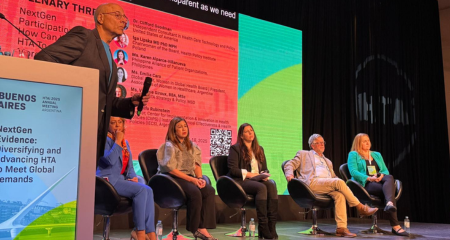
In the fast-paced global health landscape, the quest for transparent, equitable, and fair health systems is more urgent than ever. And health technology assessments (HTAs), with their mission to ensure transparency in decision-making, can play a role as a catalyst for more just and resilient health systems, according to the organizers of the third plenary session of the HTAi 2025, the world congress of ETS that took place in Buenos Aires.
"We need to ensure participation. And that includes transparency, equity, diversity, justice, and trust," reflected the session moderator. Dr. Clifford Goodman, an independent consultant on health policy and technology in the United States and former president of HTAi. But how can this be achieved?
The first exhibitor, Karen Alparce-Villanueva, director of the Philippine Alliance of Patient Organizations, cited studies showing a lack of trust and familiarity between HTA agencies and patient groups, which hinders greater participation. “Patients are unfamiliar with the HTA process, don't understand medical jargon, and lack the capacity to generate evidence,” she listed.
Emilia Caro, Argentine molecular biologist and data scientist, president of the Association of Women in HealthcareHe posited that the ETS has immense power because it defines what is valuable. “But the point is that perhaps we need to work together and bridge different silos. We're working to make it valuable for whom? Is it accessible for whom? And is it prioritized by whom? Those are the questions we need to address. Because the best valuation from a technical perspective can be deeply unfair if we ignore who's behind it,” he said.
Caro added that health technologies are embedded in very complex realities, which are always conditioned by gender, age, diversity, income, and power. “Therefore, we need to be very clear about whose voices we listen to when we talk about equity,” she emphasized. She proposed that equity in HTA is not charity, but smart policy, because it protects trust and prevents backlash. “It builds systems that don't collapse because they were designed for everyone and allows HTA to become not just a guardian, but a guardian of justice,” she concluded.
El Dr. Adolfo Rubinstein, director of the Center for Innovation and Implementation in Health Policies (CIIPS) at IECS, explained that having been on both sides of the bar (as a research epidemiologist and as Argentina's Minister of Health), he was able to understand the very different perspectives of those who generate evidence or translate it into the real world, and those in charge of deciding on policy adoption and implementation. “They have different languages, cultures, norms, jargon, and codes. And so, engaging policymakers is not just about presenting data or research evidence, but also about presenting a compelling narrative and a values framework aligned with policymakers, which is different from the values framework of HTA researchers,” he maintained.
Policymakers often have to make very difficult decisions when balancing innovation, on the one hand, and equity, efficiency, and sustainability, on the other, noted Dr. Rubinstein, who exemplified this with the growing emergence of high-priced innovative drugs that hold great promise but have marginal profitability and high budgetary impact. “How do we address the dilemma posed by some rare diseases that have effective treatments but compromise health budgets in the short term? It's a very difficult dilemma,” he said. He concluded: “The great challenge of HTA is how to bridge the gap between innovation, efficiency, and equity in a transparent, objective, and explicit way to serve the public good, while leaving no one behind.”
The fourth panelist, Mag. Virginie Giroux, director of HTA strategy and policy at Merck in Canada, called for increased patient engagement, starting from the design of clinical trials. “When we talk about trying to measure what really matters to patients, the question arises: what happens if what they truly value isn't a traditional clinical outcome? What happens, for example, if the value of a therapy for them lies in being autonomous and independent in their daily tasks and regaining that level of autonomy? If we, as data producers in clinical trials, can qualify, quantify, measure, and provide it for HTA, what do they do with it? And I think this raises the question of how we incorporate broader elements of value into how we do HTA.”